

 中文简体
 English
 Español



A knitting plant manager logs a defect report after the first wash trial: the fabric loses elastomeric recovery and the seams begin to pucker. The yarn in question looks normal on a cone, but the core has slipped inside the sheath. Core spun yarn prevents this by locking a functional core inside a protective cover. The core, whether it is spandex, high-tenacity polyester or a micro-denier filament, carries the mechanical work. The sheath, whether it is cotton-like, bright or matte, carries the fabric surface. When you understand that separation, you can specify core spun yarn with far more confidence.
What Is Core Spun Yarn and How Does It Work?
Core spun yarn is a composite yarn in which a filament or bundle forms the center axis and staple fibers wrap around the outside. The core provides tensile strength, elasticity, or a specific functional property. The sheath provides the hand, appearance and processability that downstream machines need.
In an ordinary spun yarn, all fibers share the same job. Strength and softness must come from the same blend, so trade-offs are unavoidable. Core spun yarn separates those roles. One filament can be engineered for tenacity while the outer sheath is engineered for touch. That is why a fabric can have both a high stretch level and a soft, cotton-like surface in the same structure.
For a polyester fiber producer, this is a meaningful shift. A customer does not have to choose between a high-tenacity yarn and a comfortable one. They can choose a core spun yarn built with a 75D or 100D polyester core and a cotton-like sheath. The same yarn will run on a knitting machine, take a smooth dyeing cycle, and deliver a fabric that feels natural yet recovers well.
Common Core Spun Yarn Types in Commercial Textile Production
The commercial range of core spun yarns can be grouped into three broad families. Each family solves a different set of fabric problems.
Elastic Core Spun Yarn
The most common elastic version is built with a spandex core. In an air covered spandex yarn process, the spandex filament is fed through the center while polyester or other fibers are interlaced around it. This produces the recovery that stretch knits need without the surface irregularity of a bare spandex yarn.
For mills building leggings, seamless garments or woven stretch fabrics, our spandex air covered yarn for elastic fabric production covers the common denier combinations needed for these applications. A typical specification uses 20D or 40D spandex with a 75D or 150D polyester cover.
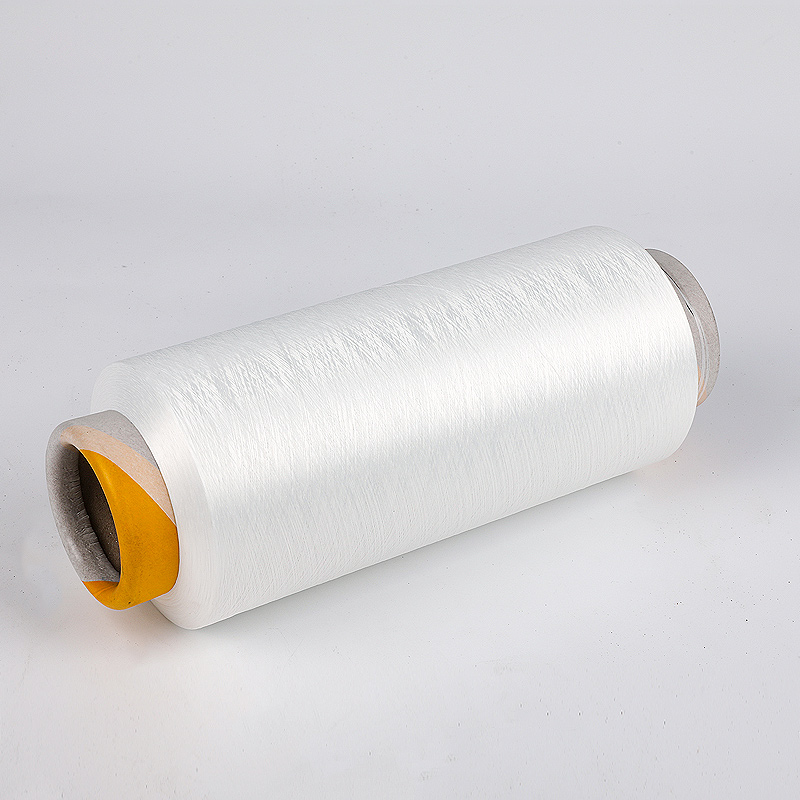 Spandex Air Covered Yarn for Stretch Fabric ProductionThis air covered yarn combines spandex with polyester or nylon for excellent stretch and recovery. Its soft, lightweight structure makes it suitable for sportswear, hosiery, and intimate apparel, offering comfort and durability in motion.View Product →
High-Tenacity Core Spun Yarn
When seam strength and durability are the priority, the core is made from high tenacity DTY yarn or a fully drawn polyester filament. The outer sheath can still be a softer fiber, which allows the yarn to run on standard looms without compromising the surface hand.
These yarns are common in workwear, sewing threads, protective textiles and technical woven fabrics where the fabric must resist seam slippage and repeated tension.
Micro-Denier and Functional Core Yarns
In the third family, the core is made from a micro-denier filament or a dissolvable island structure. Sea island yarn for micro-fiber textiles is one route to produce fabrics with a very fine, silky hand. The island structure creates microfibers during finishing, which is useful for synthetic suede, high-density fabrics and fine-texture apparel end uses.
Ultra-fine Sea Island Yarn for Microfiber TextilesSea island yarn produces microfibers during finishing, creating a soft, silky hand and strong moisture absorption. It is ideal for synthetic suede, high-density fabrics, and premium garments requiring fine texture.View Product →What to Check Before Ordering Core Spun Yarn
Buying core spun yarn is not the same as buying a regular ring-spun yarn. Because the core and sheath have different tension requirements, the specification sheet needs to tell you more than just count and color. The table below lists the points that cause most problems after bulk production starts.
| Parameter | What to Verify | Practical Impact |
|---|---|---|
| Core material | Spandex, polyester, nylon | Sets elasticity, strength and cost |
| Core denier | 20D, 40D, 75D, 150D | Changes recovery and fabric weight |
| Sheath cover ratio | 60% to 90% | Controls coverage, hand and pilling |
| Elongation at break | 20% to 45% for elastic cores | Determines wash recovery and bagging |
| Twist level | TPI or TPM | Affects surface texture and machine runnability |
| Winding quality | Package density, kick-off tension | Prevents filling breaks at high speed |
One area that deserves extra attention is core pre-tension. If a spandex core is pre-drafted too tightly, it may not recover fully after dyeing. If it is too loose, the fabric will feel stiff. A reliable supplier will document the pre-draft value and the elongation tolerance for each lot so you can compare the yarn behavior against your own knitting process.
Applications Across Apparel, Home Textiles and Technical Fabrics
Core spun yarn is most useful where a fabric must satisfy contradictory requirements. Below are the practical situations where the yarn construction helps most:
- Athletic wear and leggings need high stretch plus a dry, smooth hand.
- Woven workwear needs seam strength plus wash-and-wear comfort.
- Knitted outerwear needs dimensional stability plus natural softness.
- Home textiles, especially curtains and upholstery, need shape retention on wide widths.
- Technical textiles need a load-bearing core with a surface that survives finishing.
In the case of soft apparel, a cotton-like yarn for a soft and natural hand can sit as the outer sheath over an elastic or high-tenacity core. The final fabric then looks and feels like cotton, while the internal structure delivers the elasticity or strength required for the end use.
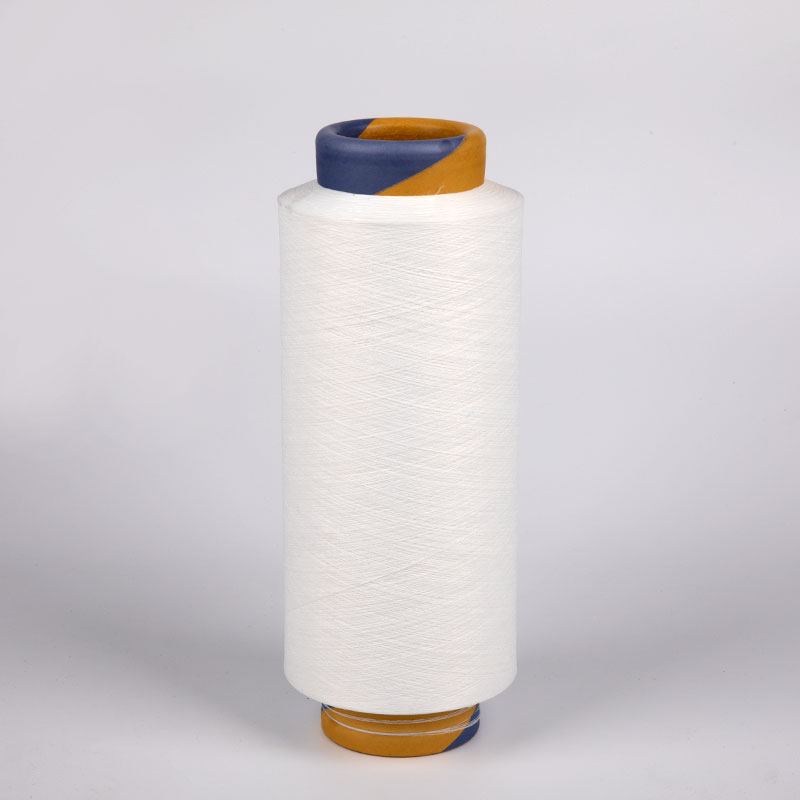 Cotton-like Yarn for Soft Natural HandfeelThis cotton-feel yarn mimics the softness and breathability of natural cotton while offering improved durability, easy care, and cost efficiency. Suitable for apparel and home textiles, it provides comfort with reduced shrinking and wrinkling.View Product →
At our own production site, the ability to control both POY and DTY alongside special modified fibers means the core and the sheath can be engineered with matching thermal and dyeing behavior.
Core Spun Yarn vs Regular Yarn: A Decision-Making Comparison
The real difference between core spun yarn and regular yarn shows up when you compare the same total denier on the same machine. Below is a practical comparison based on production experience:
| Aspect | Core Spun Yarn | Regular Spun or Ply Yarn |
|---|---|---|
| Strength source | Central filament | All fibers share the load |
| Elastic recovery | High with spandex core | Lower and more variable |
| Surface coverage | Uniform sheath | Fibers distribute unevenly |
| Bending resistance | Controlled by the core | Higher, especially at high twist |
| Cost per kilogram | Higher | Lower |
| Best end use | Functional apparel and technical fabric | Basic apparel and craft yarn |
The higher per-kg cost is often justified at the fabric level. In stretch knits, a core spun yarn with proper sheath coverage can cut seconds and returns from recovery failure. In woven fabrics, the seam integrity gained from a high-tenacity core reduces the risk of failures at final garment inspection.
FAQ
Q1: What is the main advantage of core spun yarn over a blend yarn?
The main advantage is the separation of function. A blend yarn averages out the properties of two fibers, so both strength and softness end up at a middle level. Core spun yarn keeps strength in the center and softness on the outside, so both can stay high at the same time.
Q2: Is core spun yarn the same as covered yarn?
Not exactly. Covered yarn is a broader category. It can be made by wrapping one yarn around another on a hollow-spindle or ring machine. Core spun yarn is normally made on a spinning frame during a single spinning operation. Both are composite yarns, but the production route and the final structure are different.
Q3: Can core spun yarn be dyed with standard polyester dyeing?
Yes, if the sheath is regular polyester. However, the core may be spandex or another filament that cannot withstand high dyeing temperatures. Mills should confirm the cover ratio and the fiber type before choosing a dyeing route. A well-built core spun yarn with sufficient cover will prevent the core from being exposed during dyeing.
Q4: What causes core exposure and how can I avoid it?
Core exposure happens when the sheath fibers are too few or the twist is too low. Insufficient cover ratio, excessive tension, or an uneven winding process can create bare spots. The best defense is to sample test and check the cover ratio with a microscope or a simple cut-and-count test before going to bulk.
Q5: What is a reasonable elongation for elastic core spun yarn?
For a typical 40D spandex core with a polyester sheath, 20% to 45% elongation is a reasonable starting point. The final fabric stretch is also affected by the knitting or weaving machine settings, so use a sample to match your specific process.

 TEL: +86-575-85510907
 E-mail:
 Qianqing Material Market, Shaoxing,Zhejiang Province,China
